
 One of my oldest and fondest childhood food memories is the first time that I was introduced to Irish Soda Bread. At the time we lived in Spring Valley, New York. My neighborhood friends, Sean, Kirin and Deirdre Murphy, were from Ireland, and their aunt Carole was the first person to serve me Irish Soda Bread. I don’t remember details about how the bread itself was made, but what has stuck with me for 40 years is how she served it and the combination of flavors that I experienced. Imagine being eight years old and a curious eater with a sweet tooth when someone places a slice of fresh bread topped with strawberry jam and freshly made whipped cream in front of you. I was in heaven! For me, the magic is in the combination of the caraway, raisins, jam and cream.
Traditional Irish soda bread dates back to the early 1800s, when baking soda (or “bread soda”) became widely available in Ireland and provided a simple way to leaven bread without yeast. The earliest versions were extremely humble – made with little more than soft wheat flour, sour milk or buttermilk, salt, and baking soda. These plain loaves were staples of rural households, particularly during and after the Irish Famine, when ingredients were scarce and families relied on inexpensive foods they could prepare quickly over a hearth. This richer version – also known as “spotted dog” – studded with raisins or currants and sometimes flavored with caraway seeds – came later and was associated with more prosperous homes that could afford dried fruit and sugar. This slightly sweeter variation was also sometimes called “railway bread” or “railroad bread,” as similar fruit-filled soda breads were popularized in tea rooms and railway hotels in the late 19th century, when rail travel made these treats more widely available.
If you like yours plain, you can certainly leave out the raisins and caraway
When I opened my first bakery, The Sturbridge Bread Company — and in every bakery and restaurant since then — I have made this recipe for Irish Soda Bread. I love introducing people to the combination of this bread with jam and cream and seeing the joy on their faces the first time they try it.
This bread is also delicious served with stew, corned beef and cabbage, with cultured butter or as-is, but I urge you to try it at least once with all the add ins and served with jam and cream.
Traditionally Irish soda bread has a tender but slightly crumbly, biscuit-like texture, while many modern recipes add eggs for extra richness and a softer, more cake-like crumb. Eggs are not part of the traditional recipe and are intentionally left out here.

IRISH SODA BREAD
Ingredients
- 56 grams butter (½ stick)
- 500 grams 1:1 gluten-free flour blend
- 2 tablespoons baking powder
- 1 teaspoon baking soda
- 1 teaspoon salt
- 3 tablespoons sugar
- 160 grams raisins or currents
- 1 tablespoon caraway seeds
- 400 grams buttermilk
Instructions
- Place ½ stick butter in the freezer.
- Preheat oven to 350 degrees.
- Line a baking sheet with parchment paper or a silicone baking mat.
- Whisk flour, baking powder, baking soda, salt and sugar in a large bowl.
- Remove the butter from the freezer, and quickly shred it into the flour mixture using a box grater until coarse crumbs form, and it is evenly distributed.

- Stir in the raisins and caraway seeds.
- Add the buttermilk to the dough.

- Using a wooden spoon (or your hands), gently fold the dough together until it is too stiff to stir. With lightly floured hands on a lightly floured surface, work the dough into a ball as best as you can. Knead the dough for about 30 seconds or until all the flour is moistened.
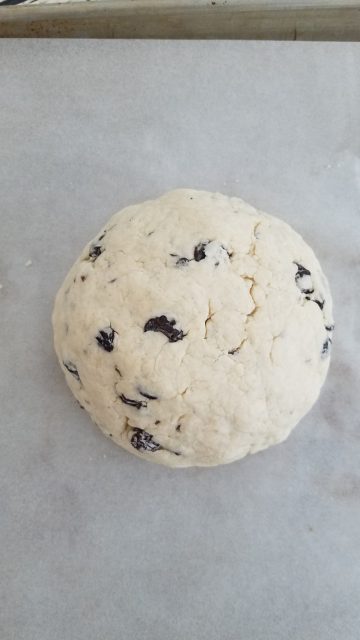
- Transfer the dough to the prepared pan. Using a very sharp knife, score an X into the top. Cover the dough with a kitchen towel or plastic wrap, and let it rest fo 20 minutes in the fridge before baking.
- Bake 45 - 60 minutes until the bread is golden brown, and the center appears cooked through. Loosely cover the bread with aluminum foil if you notice heavy browning on the top. The internal temperature should reach at least 190 degrees.
- Remove the bread from the oven, and allow it to cool for 10 minutes, before transferring to a wire rack. For the best texture, let it completely cool before slicing.
- Store the bread covered at room temperature for two days. Freeze well-wrapped loaf for up to a month.
Notes
If you don’t have buttermilk or prefer a dairy-free option, you can easily make a substitute. Measure 400 g plant-based milk (cashew milk, oat milk, or another neutral plant milk works well) and stir in 1 tablespoon (15 g) white vinegar or lemon juice. Let it sit for 5–10 minutes until it slightly thickens and looks lightly curdled. This creates the same acidity needed to react with the baking soda and helps give the soda bread its traditional rise and tender crumb. Another great substitute (not dairy Free) for buttermilk is Kafir which works as a 1:1 substitute.

A lovely treat, I leave out the caraway.
Made this again this year for St. Patty’s Day!! 2 years in a row! Delicious and moist!